<?xml version="1.0" encoding="utf-8"?>
<feed xmlns="http://www.w3.org/2005/Atom">
    <title>chaff</title>
    <link rel="alternate" type="text/html" href="http://husk.org/blog/" />
    <link rel="self" type="application/atom+xml" href="http://husk.org/blog/atom.xml" />
    <id>tag:husk.org,2009-01-09:/blog//1</id>
    <updated>2012-04-02T06:40:59Z</updated>
    <subtitle>occasional witterings. very occasional.</subtitle>
    <generator uri="http://www.sixapart.com/movabletype/">Movable Type Open Source 4.1</generator>

<entry>
    <title>A Fuller Review- Bucky and the Bay Area</title>
    <link rel="alternate" type="text/html" href="http://husk.org/blog/arch/the_utopian_impulse.html" />
    <id>tag:husk.org,2012:/blog//1.110</id>

    <published>2012-04-02T00:00:00Z</published>
    <updated>2012-04-02T06:40:59Z</updated>

    <summary>SFMOMA&apos;s Buckminster Fuller exhibition is really about his influence on the West Coast, which is interesting, but not a patch on the man himself.</summary>
    <author>
        <name>Paul Mison</name>
        <uri>http://husk.org/</uri>
    </author>
    
        <category term="essays" scheme="http://www.sixapart.com/ns/types#category" />
    
        <category term="wanders and observations" scheme="http://www.sixapart.com/ns/types#category" />
    
    
    <content type="html" xml:lang="en" xml:base="http://husk.org/blog/">
        <![CDATA[<p>This weekend saw the public opening of <a href="http://www.sfmoma.org/exhib_events/exhibitions/439">The Utopian Impulse: Buckminster Fuller and the Bay Area</a> at SFMOMA, the city's modern and contemporary art museum. I thought I should pop in and have a look.</p>

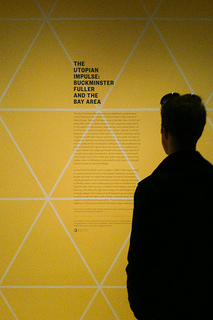
<p><a href="http://www.flickr.com/photos/blech/6888084972/"><span class="mt-enclosure mt-enclosure-image" style="display: inline;"><img alt="6888084972_4cca890aed_n.jpg" src="http://husk.org/blog/6888084972_4cca890aed_n.jpg" width="213" height="320" class="mt-image-right" style="float: right; margin: 0 0 20px 20px;" /></span></a>SFMOMA is (still) the only museum here I'm a member of. It's downtown, it has a heavy focus on photography (one of my favourite visual forms), and shows some interesting contemporary art. It also features a couple of rooms that tend to be dedicated to design, and it's these that host The Utopian Impulse.</p>

<p><a name="ret1"></a>The entrance and first room are dedicated to Buckminster Fuller's work, with a large Dymaxion map - his design for a world map that's based on an unfolded icosahedron (or cubeoctahedron, although those aren't represented here) to minimise the distortions inherent in displaying a sphere on a flat surface - along with <em>Inventions: Twelve Around One</em>, a series of prints by Chuck Byrne that fuse diagrams and sketches with photographs of Fuller and his inventions. There's also a shelf of the designer's<a href="#fn1">¹</a> books, along with a display table featuring such lesser-known images as one of his Tetrahedral City proposal, a vast polyhedra situated in the San Francisco Bay.</p>

<p>There's not much new here, though, if you're already aware of Fuller's work. The much larger second room is, by contrast, dedicated to the Bay Area artists, designers, architects, and inventors who've been inspired by it. Here you'll find video, models, artworks, and products from the Ant Farm's proposals for a <a href="http://amandalynnpaintings.blogspot.com/2012/03/moma.html">Convention City</a>, Whole Earth Catalogs, the North Face <a href="http://www.oregonphotos.com/Geodesic-tent1.html">Oval Intention</a> tent, Nicholas de Monchaux's<a href="http://nicholas.demonchaux.com/Work/local-code-at-the-biennial-of-the-americas"> Local Code</a>, the One Laptop Per Child project, and various models and designs for buildings both <a href="http://morphopedia.com/projects/san-francisco-federal-building">built</a> and unbuilt.</p>

<p>It's definitely interesting (and slightly overwhelming) to see how this region has developed his ideas, even if some of the connections seem a little tenuous and could do with further explanation. The final (small) corridor, showing interviews and images from the <a href="http://www-sul.stanford.edu/depts/spc/fuller/about.html">Dymaxion Chronofile</a> projected onto a custom-designed flattened icosahedral screen, helps somewhat to make the links more explicit; one segment I saw featured Stewart Brand and his "why haven't we seen a picture of the whole earth" campaign, for example. It's also, frankly, a rather amazing piece of AV sculpture.</p>

<p>Would I recommend the exhibition? If you're already in San Francisco or plan to be, and especially if you have a friend who can get you into the museum, then yes, it's well worth a look. However, it's small enough that I really can't suggest anyone travel here. It also makes much more of the Bay Area links than it does provide an overview of Buckminster Fuller's work. Comparing it to the photos and description of the <a href="http://whitney.org/Exhibitions/BuckminsterFuller">Whitney's show in 2008</a>, it's really just an amuse bouche. It's also a shame, because for all that this work is worth looking at, it doesn't fascinate the same way Fuller's designs themselves do.</p>

<p><small>Further reading: the <a href="http://www.sfmoma.org/about/press/press_exhibitions/releases/903">exhibition press release</a> is the museum's own summary of the show. I've also uploaded <a href="http://www.flickr.com/photos/blech/tags/theutopianimpulse/">some photos to Flickr</a>. The exhibition closes on 29th July, 2012.</small></p>

<p><small><a name="fn1"></a>¹ One of the problems with Buckminster Fuller is finding a word to describe him. The Whitney uses "visionary", which is probably right, but for some reason I can't quite bring myself to write that. "Designer" is perhaps not enough either, but I'm more comfortable with it.<a href="#ret1">↩</a></small></p>]]>
        
    </content>
</entry>

<entry>
    <title>More Thoughts On Pagination</title>
    <link rel="alternate" type="text/html" href="http://husk.org/blog/arch/more_thoughts_on_pagination.html" />
    <id>tag:husk.org,2012:/blog//1.109</id>

    <published>2012-03-27T16:40:00Z</published>
    <updated>2012-04-01T23:58:35Z</updated>

    <summary>Nolan Caudill made some good suggestions about pagination, so I did what I do best: pointing at specific examples, and suggesting a few further ideas.</summary>
    <author>
        <name>Paul Mison</name>
        <uri>http://husk.org/</uri>
    </author>
    
        <category term="computing" scheme="http://www.sixapart.com/ns/types#category" />
    
        <category term="essays" scheme="http://www.sixapart.com/ns/types#category" />
    
    
    <content type="html" xml:lang="en" xml:base="http://husk.org/blog/">
        <![CDATA[<p><a name="ret1"></a>For the last month or so, Flickr have been starting to roll out their new <a href="http://www.flickr.com/photos/blech/favorites/?view=ju">"justified" view</a> across the site. It's very pretty, and generally I'm a fan, but <strike>as well as the possible criticism of the reliance on JavaScript,</strike><a href="#fn1">¹</a> it's meant that the easy access to page numbering on the <a href="http://www.flickr.com/photos/blech/favorites/?view=sm" title="Pagination is actually available in Justified; it's just way further down the page">old views</a> has been lost. An off-the-cuff (and admittedly somewhat snarky) remark on Twitter prompted <a href="http://nolancaudill.com/about/" title="Nolan's always been better about these things than I have.">Nolan Caudill</a> to write a well-thought-out <a href="http://nolancaudill.com/2012/03/24/pagination/" title="Thoughts On Pagination">post about pagination</a>.</p>

<p>In it, he agreed with my point about infinite scrolling:</p>

<blockquote>Infinite scrolling is basically a pretty representation of the 'next' link that you 'click' by scrolling to the bottom of a page. I'll leave whether or not it's good user experience to others, but as a purely visual experience, I like it. If it's the only source of pagination, that sucks, and another navigation scheme should be provided if having your users be able to look through the list or find something is important.</blockquote>

<p>but he also made a very good point about the failings of traditional "n per page" links:</p>

<blockquote>Pagination should provide accurate navigation points that reflect the overall ordering of the stream, and pagination based around fixed-length pages provide nothing more than arbitrary access into this ordering, where we have to use estimation and instinct about the distribution of the content in order to make a guess of where a link will send us</blockquote>

<p>He goes on to suggest time-based navigation, somewhat like the letter tabs often found in dictionaries. In fact, many sites already implement their APIs this way- Flickr included. <a href="https://twitter.com/">Twitter</a> makes copious use of <code>max_id</code> (and this is well-explained in <a href="https://dev.twitter.com/docs/working-with-timelines">their documentation</a>), while <a href="http://instagram.com/developer/endpoints/media/">Instagram</a> use <code>max_timestamp</code> and <code>min_timestamp</code>. There are <a href="http://www.flickr.com/services/api/flickr.favorites.getList.html">places</a> in the Flickr API that can use <code>min_timestamp</code> and <code>max_timestamp</code>, although there are also traditional page parameters in that call.</p>

<p>It's not just APIs, though. <a href="http://notes.husk.org/archive">Tumblr's archives</a> are infinite-scroll, but with a month selector so you can skip back and forth through time. (That's on the desktop web, anyway: for some reason the iPad version omits the form.) It's not perfect - if you post hundreds (or thousands) of entries in a month, it's hard to pick them out - but for most users, it works fairly well.</p>

<p>Of course, having said all this, I should really implement something that mixes the visual niceness of justified view with the navigational panache of a timeline. One thought I did have is that a small (sparkline-style?) bar graph of posts over time, although computationally expensive across large archives, would definitely help to highlight busy points to look at (or, depending on whether your friends upload too many photos from trips, avoid). Definitely something to consider playing with.</p>

<p><small><a name="fn1"></a>¹ Oops: I didn't test this, but <a href="https://twitter.com/ysaw/status/184708706053799936" title="'js is not required for justified view.'">Stephen Woods correctly pointed out</a> that JavaScript is only used to delay loading and extend the number of photos shown, and that the page works fine with JS disabled. <a href="#ret1">↩</a></small></p>]]>
        
    </content>
</entry>

<entry>
    <title>Introducing docent</title>
    <link rel="alternate" type="text/html" href="http://husk.org/blog/arch/introducing-docent.html" />
    <id>tag:husk.org,2010:/blog//1.108</id>

    <published>2010-01-28T18:20:00Z</published>
    <updated>2010-02-10T08:27:03Z</updated>

    <summary>I recently launched a small web app called docent. Here&apos;s some of the decisions behind the process.</summary>
    <author>
        <name>Paul Mison</name>
        <uri>http://husk.org/</uri>
    </author>
    
        <category term="computing" scheme="http://www.sixapart.com/ns/types#category" />
    
        <category term="essays" scheme="http://www.sixapart.com/ns/types#category" />
    
        <category term="python" scheme="http://www.sixapart.com/ns/types#category" />
    
    
    <content type="html" xml:lang="en" xml:base="http://husk.org/blog/">
        <![CDATA[<h4>Flickr and galleries</h4>

<p>It's now a little over four months since Flickr launched their <a href="http://blog.flickr.net/en/2009/09/14/galleries-unleash-your-inner-curator/">galleries</a> feature. I liked it as soon as I saw it: it's taken a frequent request ("how can I have sets of favourites?") and delivered something that does the same job, but in a different way. I know some people quibble about some of the constraints, but I like the limited number of photos you're allowed, and generally I've enjoyed creating and browsing them.</p>

<p>Unfortunately, there's a problem: discovering other people's galleries. Aaron Straup Cope is good at <a href="http://delicious.com/search?p=a+gallery+on+flickr&chk=&context=userposts%7Cstraup&fr=del_icio_us&lc=0">bookmarking them on delicious</a>, and there's an <a href="http://www.flickr.com/galleries/">Explore page</a>, but neither of those necessarily find things I'd like to see.</p>

<h4>The gist of it</h4>

<p>Just over three weeks ago, Kellan announced <a href="http://www.flickr.com/groups/api/discuss/72157622404753248/72157623155744596/">the first API support for galleries</a>, and I quickly <a href="http://gist.github.com/273614">created a Python script</a> that would go through all my contacts and fetch their galleries. It was useful, and it turned up a lot of galleries I hadn't seen, but it had two big flaws: nobody else would use it, and it wasn't pretty.</p>

<h4>App Engines and data models</h4>

<p><a name="ret1"></a>I've used App Engine in the past, but that was before the advent of their experimental <a>Task Queue API</a>, and I didn't use the <a href="http://code.google.com/appengine/docs/python/datastore/">datastore</a>. Using Aaron's <a href="http://github.com/straup/gae-flickrapp">gae-flickrapp</a> as a core, I spent about a week's worth of evenings on and off learning how to use both, ending up with the core of <a href="http://docent.husk.org/"><b>docent</b></a><a href="#fn1">¹</a>, a small web app.</p>

<p>There are only four kinds of object: dbFlickrUser, from gae-flickrapp, which handles logged in users; Contacts, which have a one-to-one relationship with dbFlickrUsers; FlickrUser, which is an object for a user docent knows about but who isn't necessarily logged in; and Gallery, which stores information about the gallery itself.</p>

<h4>What it does</h4>

<p><a name="ret2"></a><a name="ret3"></a>When you first log in, a task is added to a high-priority queue to fetch your contacts from Flickr. The NSIDs<a href="#fn2">²</a> from this call are stored in a single ListProperty in the Contacts object, and then a new task is added to a lower-priority queue. This goes through the IDs one by one, fetching the galleries Atom feed<a href="#fn3">³</a> and creating the relevant objects (if necessary). This, and the various tasks to update galleries for older users, make up the bulk of the CPU load of the app, and almost all of the Datastore writes.</p>

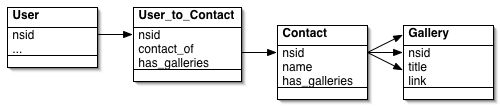
<p>The big difference between traditional ORMs and the way I'm using the App Engine datastore comes into play here. In an ORM such as Django, a dbFlickrUser would have a many-to-many relationship with FlickrUsers, which would then have a one-to-many relationship with Galleries. The former would require a join table between them. The query to fetch all galleries from a single user would look something like <tt>galleries = Gallery.objects.filter(owner__contact_of__nsid=nsid)</tt></p>

<p><span class="mt-enclosure mt-enclosure-image" style="display: inline;"><img alt="orm.png" src="http://husk.org/blog/assets/orm.png" width="500" height="106" class="mt-image-none" style="" /></span></p>

<p>By contrast, in the datastore, Both FlickrUser and Gallery objects have a contact_of ListProperty. As a new user's contact list is examined, their NSID is added to the contact_of list. This is how the pages showing galleries for a contact are built: it's a simple equality test, which is translated behind the scenes to a list-membership test:</p>

<p><tt>galleries = Gallery.all().filter('contact_of =', nsid).fetch(256)</tt></p>

<p><span class="mt-enclosure mt-enclosure-image" style="display: inline;"><img alt="gae.png" src="http://husk.org/blog/assets/gae.png" width="248" height="75" class="mt-image-right" style="float: right; margin: 0 0 16px 16px;" /></span> It took a lot of fiddling to break out of the ORM/SQL mindset, based on joins, but I think I'm happier now I have. On the other hand, keeping the contact_of lists on all the objects in sync is something of an overhead, and the query code isn't significantly easier. There's also a rather severe limitation I only ran across later.</p> 

<h4>Onto the Flickr blog</h4>

<p><a name="ret4"></a>This was all well and good as I let a few other people at the site; initially close friends, then via a couple of screenshots on Flickr, before inviting a bit more of a burst of users via Twitter. The site seemed to be scaling fine; there was a lot of CPU used fetching contacts, which eventually I managed to optimise by being more selective about updating from the gallery feeds.<a href="fn4">⁴</a> In fact, the FlickrUser object is currently pretty much a stub, although I'm thinking of changing that.</p>

<p>However, when docent made the <a href="http://blog.flickr.net/en/2010/01/27/docent-your-guide-to-galleries/">Flickr blog</a>, it hit a serious issue: exploding indexes. The version of the app that was live was doing this query:</p>

<pre>galleries = Gallery.all().filter('contact_of =', nsid)
                         .order_by('-published')
                         .fetch(offset, per_page)</pre>

<p>That extra "order_by" criteria required an additional index, and because it's combined with a ListProperty (namely contact_of), it hit the problem documented in the <a href="http://code.google.com/appengine/docs/python/datastore/queriesandindexes.html#Big_Entities_and_Exploding_Indexes">Queries and Indexes</a> page:</p>

<blockquote>Custom indexes that refer to multiple properties with multiple values can get very large with only a few values. To completely record such properties, the index table must include a row for every permutation of the values of every property for the index.</blockquote>

<p>When I last looked, docent knew about 14,000 or so galleries. While most had small contact_of lists, some no doubt expanded to dozens of people, and so the index was too large to store. As a workaround, I eventually realised I had to abandon sorting in the query and instead use Python, at which point the app started being responsive again. Lesson learnt, the hard way.</p>

<h4>Moving On</h4>

<p>So, what now? The app is up, and although there are a few errors still happening, they're mainly in background tasks that can be optimised and retried without any impact on users. Personally, it's been a fairly good, if occasionally intense, introduction to App Engine's unique features.</p>

<p><a href="ret5"></a>Would I do things this way again in future? I'm not sure. Turning the relationship model on its head hasn't led to an obvious improvement over the ORM+SQL methods I'd use in, say, Django, and while the Task Queue API is very easy to use, it's hard to develop with (since it has to be fired manually locally) and there are other job queue solutions (such as <a href="http://github.com/tobi/delayed_job">Delayed Job</a>, for Rails, as used on Heroku). On the other hand, even with the heavy load, and not the best of optimisations, docent almost stayed within the App Engine free quota CPU limits<a href="#fn5">⁵</a>, and didn't approach any of the others.</p>

<p>In any case, I'm happy to have produced something so useful, and hope that anyone who tried using it yesterday only to run into errors feels willing to try again. In the meantime, I'm sure there'll be more scaling roadbumps as the site gains users and more galleries are added, but I'm looking forward to fixing them too. Please, <a href="http://docent.husk.org/">try docent out</a>.</p>

<p>(I know comments aren't enabled on this site at the moment. Feel free to add them on <a href="http://www.flickr.com/services/apps/72157623057785637/">docent's page on Flickr's App Garden</a>.)</p>

<p><small><a name="fn1"></a>¹ Why "docent"? Originlly it was the unwieldy gallery-attendant, but <a href="http://anti-mega.com/antimega/">Chris</a> suggested the name, based on a term more common in the US than here for the <a href="http://museumhistorystudies.suite101.com/article.cfm/become_a_museum_docent">guide to a museum</a> or gallery. <a href="#ret1">↩</a>

<br>

<a name="fn2"></a>² NSIDs feel like the primary key for Flickr users: in methods like <a href="http://www.flickr.com/services/api/flickr.people.getInfo.html">flickr.people.getInfo</a>, it's one of the key pieces of returned information, and it can be used in <a href="http://www.flickr.com/services/feeds/docs/photos_public/">feeds</a> to fetch information as well as <a href="http://www.flickr.com/services/api/misc.urls.html">URLs</a> to photos and profile pages.<a href="#ret2">↩</a>

<br>

<a name="fn3"></a>³ Using feeds rather than API calls can be handy. For one thing, they don't count against your API queries-per-second count; hopefully they're cached more aggressively, both via the <a href="http://www.feedparser.org/">feedparser library</a> and on Flickr's side so they take less resources.<a href="#ret3">↩</a>

<br>

<a name="fn4"></a>⁴ One nice thing about getting more users is that the likelihood of finding a contact's galleries in the data store already goes up. When I was developing, I had to fetch everything; for the second user, there was some overlap, saving calls. As the site gets bigger, the number of fresh gallery fetches should keep fairly low.<a href="#ret4">↩</a>

<br>

<a name="fn5"></a>⁵ Since I last <a href="http://husk.org/blog/arch/aggregation_and_the_edge.html">wrote about App Engine</a>, it's grown the ability for users to pay for resources beyond the free quota levels. I decided to do this when I hit about 55% of my CPU quota, and the app did indeed reach about 120% yesterday. I don't have a bill yet but I expect it to be under $0.50, which is fine.<a href="#ret5">↩</a></small></p> ]]>
        
    </content>
</entry>

<entry>
    <title>Olympus PEN E-P1: A Hands On Review</title>
    <link rel="alternate" type="text/html" href="http://husk.org/blog/arch/olympus_pen_e-p1-hands-on.html" />
    <id>tag:husk.org,2009:/blog//1.107</id>

    <published>2009-06-29T14:19:13Z</published>
    <updated>2009-06-29T14:38:24Z</updated>

    <summary>I had a chance to try the new Olympus PEN E-P1 camera at the weekend. It&apos;s good to see some innovation, and I&apos;d recommend it, but it&apos;s not for me.</summary>
    <author>
        <name>Paul Mison</name>
        <uri>http://husk.org/</uri>
    </author>
    
        <category term="essays" scheme="http://www.sixapart.com/ns/types#category" />
    
        <category term="images" scheme="http://www.sixapart.com/ns/types#category" />
    
    
    <content type="html" xml:lang="en" xml:base="http://husk.org/blog/">
        <![CDATA[<h4>Introduction</h4>

<p>The big digital photography news this month has undoubtedly been the launch of the <a href="http://asia.olympus-imaging.com/products/dslr/ep1/">Olympus PEN E-P1</a>. If you're not the sort of person who checks sites like <a href="href="http://www.dpreview.com/">DPReview</a> (where the PEN has taken top place in <a href="http://www.dpreview.com/reviews/stats.asp">"most popular cameras"</a>), the E-P1 is a rather strange, interesting new camera. Using a system called Micro Four Thirds, it offers interchangable lenses, a relatively large sensor, and by abandoning the mirror and pentaprism of a true SLR in favour of "live view" technology, a compact body. I was lucky enough to have the chance to spend a few hours playing with one over the weekend, and here's what I thought.</p>

<p>There's been a small but vocal section of the photography community wanting a small, well-specified, prime-lensed camera for years. Mike Johnston's classic <a href="http://www.luminous-landscape.com/columns/DMD.shtml">Decisive Moment Digital</a> post set out what he wanted in a digital camera, and why the traditional compacts and SLRs failed to satisfy. For the last few years, people have tried the Ricoh GR-D cameras, the Panasonic LX-2 and LX-3 (and their Leica rebadgings), Sigma's DP1 and DP2, and all had been found lacking. When <a href="http://www.dpreview.com/news/0809/08092208olympus_micro_four_thirds.asp">Olympus unveiled their prototype</a> last year, people hoped their desires might soon be met.</p>

<p><img src="http://asia.olympus-imaging.com/products/dslr/ep1/style/images/front01.jpg" alt="Front view of the Pen" style="float:right; padding:0px 0px 8px 16px;">So, how does the E-P1 actually hold up? Sadly, the final design isn't quite as nice as the prototype, but the addition of the grip bulge on the right hand side works well. Physically, it's about half the volume of my <a href="http://www.flickr.com/photos/blech/3670780615/%5D">Canon 450D</a> (XSi), and about 50% larger than my <a href="http://www.flickr.com/photos/blech/3671587334/">Fuji F-30</a> (although the prime lens, as you'd expect, protrudes less). The silver colouring makes it look somewhat consumer-centric; an all-black version would definitely be nice.</p>

<p><a name="r1"></a><a name="r2"></a>Olympus have delivered both "pancake"<a href="#f1">¹</a> (17mm f/2.8, 34mm equivalent) and zoom (14-45mm) lenses at launch, with adaptors for both Leica M and full-size Four Thirds mounts (which I didn't get to play with). I'm pleased to see the choice of a wide lens, since the 2x crop factor<a href="#f1">²</a> means what are standard lenses for film are zoom lenses for the Pen. The UK has bundles with body-only, either kit lens, and finally one with both lenses, although bafflingly, this mixes the colours (what on earth is the thinking there?).</p>

<h4>In use</h4>

<p>In the hand, the camera is nice and dense; apparently it's made of metal, and certainly feels that way. The one I was using had a neck strap which was quite thin, hung too low, and is apparently a fairly expensive extra; perhaps Olympus have taken the retro thing too far. Of course, as there's no mirror, you compose your image on a screen. The lack of mirror also makes the shutter silent, which is a nice change from an SLR.</p>

<p>The screen was certainly bright enough on a cloudy London evening, but I'm not sure how it would be in direct summer daylight. There is an optional viewfinder, but that's fixed for the 17mm, and I didn't have it during my walkabout. I did try it quickly in Jessops on Thursday, and framing seemed correct, but of course it won't show depth of field or a focussing preview.</p>

<p>Speaking of focussing, it's handled nicely, considering the lack of a direct light path; using the focus ring on the lens causes the live view to flip to a 1:1 pixel view of the centre, which seemed to be perfectly usable when I tried it. Generally autofocus was reliable, but towards the end of the walk (at past 9pm, under cloud) there was a bit of focus seeking with the zoom lens. Speaking of that lens, it has a neat feature, letting it collapse up for storage. I think that both lenses have the same lens cap diameter, but differing filter threads: the prime is 37mm, the zoom 40.5mm.</p>

<p>Naturally, the Pen has an orientation sensor (one of those features that tends to be forgotten by reviewers, but which can be annoying when absent), but it also has a view mode where there are two on-screen level meters, which is handy for architectural shots. In fact, there are a wide range of display overlays, including a grid, a rule of thirds view, a live histogram, and a multiple-shot view. Unfortunately I forgot to take a picture of this in action, but it seemed to work well.</p>

<p>The screen doesn't fold out (something that until recently was confined to compacts, but which has spread to SLRs), but it is visible from fairly wide angles (I held it above my head and was able to make out enough to frame pictures). There's the now-obligatory video mode, which offers HD (at 1280x720, not the larger 1080 size), and it seemed fine, even in lowish light. (I didn't get to take one of my usual "train entering the station" videos, but I did get some on an escalator.)</p>

<p>Speaking of low light, the Pen can be pushed to ISO 6400. I tried this on a couple of shots inside a restaurant (with dim, reddish lighting),  and while the grain is very noticeable at full size, scaled for the web (or even full screen), the <a href="http://www.flickr.com/photos/blech/3666700046/in/set-72157620677544810/">image is completely usable</a>, with a grain-like quality, if anything. Combined with the relatively wide f/2.8 on the prime lens, I'd say low light performance would be considered good by anyone who's not used to a modern DSLR.</p>

<p>A drawback that's plagued digital cameras since their invention, shutter lag, is unfortunately also a problem for the E-P1. I first noticed this when trying to take video; I'd see a cyclist under the Queen Elizabeth Hall start moving, and click the shutter, but it would take a good second or two to start up, missing the action. I tried a few other times to take still photos while walking and the problem was the same in that mode. Perhaps it was due to focussing time, since it was perfectly fast in continuous shooting, and I could have been asking too much, but I'm sure it's slower than I'm used to from my Canon SLR.</p>

<p>More minor, but perhaps also noteworthy, is the fact the combination of the prime lens's maximum aperture of f/2.8 and the 2x crop factor mean that getting narrow depth of field is a little trickier than it would be at full-frame (or even a 1.6x crop with a f/1.4 lens). Having said that, there's some nice depth of field on <a href="http://www.flickr.com/photos/blech/3666732422/in/set-72157620677544810/">this portrait</a> (which I didn't take). One final niggle: the picture review seemed a bit slow to come up. If you don't <a href="http://en.wikipedia.org/wiki/Chimping">chimp</a>, you won't care.</p>

<p>To be fair, neither of these were serious issues in most of the shots I was taking, since I usually shoot buildings, details, signs, and other things that don't move, and I suspect a bit more time on my part to think about how to roll with the camera would have made even more difference. Still, they definitely need to be mentioned.</p>

<p>I've posted a <a href="http://www.flickr.com/photos/blech/sets/72157620677544810/">set of images and videos</a>, with original size available, on Flickr. I'm not a pixel-peeper, and at web resolution they seem nice; definitely better than I'd expect from the F30, and probably about on a par with the 450D.</p>

<h4>Conclusions</h4>

<p><a name="r3"></a>I'm very happy to see this camera come to market. There's definitely room for a compact yet professional-quality camera, and this is probably the closest I've seen to being the DMD. Unfortunately, the last few years have seen the prices on digital SLRs built around the mirror/pentaprism drop so far as to squeeze this part of the market; who'll pay £700 for a body and kit lens when you can buy a Sony or Nikon for half that?<a href="#f3">³</a> On the other hand, it's a heck of a lot cheaper than <a href="http://en.leica-camera.com/photography/m_system/m8/">digital rangefinders</a>, which it can also claim to compete against.</p>

<p>Hopefully some people will look past the sticker and realise that this is something interesting. Would I recommend it? If you're looking for something pocketable but powerful, don't mind not running with the mainstream, and can justify the expense, then I'd say its unique abilities definitely make it worth serious consideration. That said, I doubt I'll get one myself. Maybe the next version?</p>

<p><b>The Good:</b></p>

<ul>
<li>Solid, sturdy feel</li>
<li>Picture quality at SLR standard</li>
<li>Sane menu structure</li>
<li>Low-light performance seemed good (although some focus seeking)</li>
<li>Olympus are genuinely trying something new</li>
</ul>

<p><b>The Bad:</b></p>

<ul>
<li>Shutter lag</li>
<li>Price - it'll have its work cut out making room in the market</li>
<li>Limited choice of lenses (but then, it is just launched)</li>
</ul>

<p><b>The Ugly:</b></p>

<ul>
<li>No black model - choice of white+cream or silver+black</li>
<li>The bundling of randomly coloured lenses</li>
</ul>

<p>Thanks to <a href="http://www.gsnowdon.com/blog/">Ghene Snowdon</a> for fixing it for me to have the chance to play with the camera. (Ghene's pretty active on <a href="http://www.flickr.com/groups/londonflickrmeetups/">London Flickr Meetups</a>; it's worth paying attention there, as I know friends who've got to try out cameras there for various reasons before.)</p>

<p><a name="f1">¹</a> <small>A pancake lens is a very thin prime (ie fixed focal length) lens, named for the fact it's as thin as a pancake.<a href="#r1">↩</a></small><br>
<a name="f2">²</a> <small>The "crop factor" is the ratio between the focal length needed for the sensor and the focal length for 35mm film. This means that, to get the same field of view as a 50mm film SLR lens would provide, the Olympus needs a 25mm lens, while my Canon SLR requires 32mm.<a href="#r1">↩</a></small><br>
<a name="f3">³</a> <small>Hopefully the next few weeks will see the street price drop a little. Canon's 450D dropped from £650 to £500 over the first three months it was on the market.<a href="#r3">↩</a></small></p>]]>
        
    </content>
</entry>

<entry>
    <title>Quick thoughts on iPhone 3GS</title>
    <link rel="alternate" type="text/html" href="http://husk.org/blog/arch/iphone-3gs.html" />
    <id>tag:husk.org,2009:/blog//1.106</id>

    <published>2009-06-09T11:35:33Z</published>
    <updated>2009-06-09T14:09:26Z</updated>

    <summary>I&apos;m going to buy iPhone 3GS when it comes out. Here&apos;s why, and </summary>
    <author>
        <name>Paul Mison</name>
        <uri>http://husk.org/</uri>
    </author>
    
        <category term="computing" scheme="http://www.sixapart.com/ns/types#category" />
    
        <category term="essays" scheme="http://www.sixapart.com/ns/types#category" />
    
    
    <content type="html" xml:lang="en" xml:base="http://husk.org/blog/">
        <![CDATA[<p>Well, I'm sold.</p>

<p>I've owned an iPod touch for eighteen months. At the time I didn't want to take a punt on the just-released iPhone, but in the intervening time the launch of the 3G hardware made me consider buying one. I'm disorganised, though, and when it got to April I decided to hold off, suspecting the hardware would be refreshed in June.</p>

<p>Of course, it has, and I'll soon be getting in touch with O2 to pre-order My First iPhone. I'm undecided on whether it's worth spending the extra for the 32GB model, but I probably will. The camera improvements (autofocus, slightly higher resolution, and video) are nice; I'm enough of a fanboy to <a href="http://cowfish.org.uk/blog/2009/06/09/where-did-it-all-go-wrong/">cheer the compass</a> (<a href="http://googlemobile.blogspot.com/2009/05/sky-map-for-android-mobile-planetarium.html">Google's Sky Map</a> would be lovely), and of course it'll be nice to have a faster device. (Will games throttle their speed on the new hardware, I wonder?)</p>

<p>Existing owners of iPhones are a bit peeved, though. Unlike the last time there was an upgrade, O2 aren't doing anything to let people upgrade early, and operators everywhere seem keen to annoy people who want tethering, either by <a href="http://www.pcworld.com/article/166343/atandt_tightlipped_on_iphone_3gss_lack_of_mms_and_tethering.html">not offering it</a> or <a href="http://www.guardian.co.uk/technology/2009/jun/09/iphone-o2-pricing">overpricing it</a>. Personally, I'm not that bothered. I know going in there's almost certainly going to be six months in late 2010 when I don't have the latest and greatest, and I dare say I'll cope. (As <a href="http://magicalnihilism.wordpress.com/">Matt Jones</a> put it on <a href="https://twitter.com/moleitau/status/2088310270">Twitter</a>, "if you like the shiny, don't be whiny.") A price cut in the UK would have been nice, but I suppose O2 don't feel they need it. Maybe if exclusivity ends?</p>

<p>(I also wonder if the loudest complainers are the same people who are used to upgrading their laptops with every speed bump? That's not a group I've ever been part of; instead, I aim to make my machines last at least their three years of AppleCare. Perhaps the first group are just more vocal, or more used to being able to buy what they want? Of course, iPhones aren't computers, but I assume people think of them as more like computers than phones.)</p>

<p>There is a subset of those vocal complainers who may have a point- developers. The iPhone platform now has devices that run the gamut from the first generation touch, which has no camera, Bluetooth, or support for microphones, to the iPhone 3GS, which has al of the above built in, plus the improvements noted above. The speed range is getting quite large too, and I can understand the desire of devs to get cheaper access to various bits of hardware. </p>

<p>For now, the best bet - outside of large companies - seems to be to find people to test things, but that's hardly the best approach. On the other hand, expecting Apple to duplicate Google's I/O stunt - handing out free phones to every attendee - wasn't likely either. I also wonder if Apple are expecting that developers will just use the emulator?</p>

<p>Still, for all the complaints - largely unjustified, as we all know telcos are like that - this is a perfectly good incremental update. As <a href="http://news.bbc.co.uk/2/hi/technology/8090513.stm">Steven Levy says</a>, "It's not a game changer." It doesn't need to be, though, and I'm sure it'll do well.</p>]]>
        
    </content>
</entry>

<entry>
    <title>More on iPhoto &apos;09 and Flickr</title>
    <link rel="alternate" type="text/html" href="http://husk.org/blog/arch/more_on_iphoto_09_and_flickr.html" />
    <id>tag:husk.org,2009:/blog//1.105</id>

    <published>2009-04-27T21:44:46Z</published>
    <updated>2009-04-27T23:08:49Z</updated>

    <summary>iPhoto &apos;09&apos;s Flickr integration held out a lot of promise, but unfortunately it&apos;s too fragile for me to be happy with it. Shame, really.</summary>
    <author>
        <name>Paul Mison</name>
        <uri>http://husk.org/</uri>
    </author>
    
        <category term="computing" scheme="http://www.sixapart.com/ns/types#category" />
    
        <category term="essays" scheme="http://www.sixapart.com/ns/types#category" />
    
    
    <content type="html" xml:lang="en" xml:base="http://husk.org/blog/">
        <![CDATA[<p>A couple of months ago, I posted some first thoughts on <a href="http://husk.org/blog/arch/iphoto_09_applescript_flickr.html">iPhoto '09 and its Flickr integration</a>. Despite the fact that it's not amenable to scripting, I liked the idea of having photos be editable in either iPhoto or Flickr that I kept using the native support to upload photos.</p>

<p><a name="return1">O</a>f course, as <a href="http://speirs.org/2009/01/30/on-the-flickr-support-in-iphoto-09/">Fraser Speirs said</a>, "iPhoto '09 really, really wants to make photosets for you." So how to upload a few images? Well, dragging an image adds it to a set, and as you'd hope, dragging images to an iPhoto set starts an upload going. However, there's a huge annoyance here: to get ordering in your photostream, you have to drop the images in one by one. (Flickr sets can be ordered post-upload, but you can't reorder your photostream<a href="#footnote1">¹</a>.)</p>

<p>Generally, the syncing of metadata has been great- when I've changed a location (or even photo) it's worked fine. However, it's also been worryingly fragile. I think I've had issues about once a fortnight with an upload failing (either because of a temporary issue with Flickr, or network congestion, or just someone sneezing down the road). iPhoto then gets into a confused state. You can't abort the sync and quit; eventually it'll either crash of its own accord, or I'll get fed up and force quit. Upon restarting, I find it's forgotten which photos existed in the set, so it downloads the originals from Flickr and breaks the connection. Either that, or it just gives up.</p>

<p>At least the worst-case has never happened: iPhoto has never deleted a photo from Flickr without me asking it to explicitly. (I'd "only" lose comments and group metadata, but that's quite enough, thanks.)</p>

<p><b>Edit:</b> Of course, just after publishing iPhoto did just that: it lost a week of photos that I'd posted via its uploader. I'm more or less able to recreate them, I think, but I've left broken links and dropped favourites. I hate to have done that to people. (For what it's worth, I think I'm somewhat to blame. See, when iPhoto gets confused, it'll delete its connection, and then restore the image by downloading it from Flickr. However, this evening, before it had finished, I deleted the "images" (actually placeholders). I'm sure that in the past, both iPhoto and myself have done this and both the Flickr and local copies have stayed intact. Today, the Flickr copies were removed.)</p>

<p>So, what now? I could hope that a point release of iPhoto makes it more reliable, but to be honest, I feel like this is actually a Really Hard Problem, and I can imagine that Apple care more about Facebook. Anyway, 8.0.2 doesn't seem to have made the slightest bit of difference, and now I've given up on the whole experiment and reverted to using Flickr Export.</p>

<p><a name="return2"></a>Of course, that don't offer two-way sync either, because previous versions of iPhoto didn't have anywhere to store the metadata, and the current version doesn't document how to<a href="#footnote2">²</a>. Aperture does have a more expressive API, so Flickr Export for that app does offer syncing (although I suspect not back-filling), and I have other reasons to consider an upgrade (not least, how to handle libraries of RAW files that easily fill a laptop hard drive).</p>

<p>Still, it feels like a lost opportunity. Ah well.</p>

<p><small><a name="footnote1"></a>¹ Actually, not quite true: you can fiddle with the "date uploaded" field, but only in the Organizer. It's not exactly drag and drop. Usually I'm fine with that, but then, I'm used to apps that behave themselves. <a href="#return1">↩</a></small><br />
<small><a name="footnote2"></a>² Apparently F-Script and PyObjC (and presumably, somehow, ObjC itself) allow you to inspect running apps, so at some point I need to figure out how to use one or more of them to inspect the blobs that I discovered were stored in the SQLite database for Flickr syncing. <a href="#return2">↩</a></small></p>]]>
        
    </content>
</entry>

<entry>
    <title>How to use Daytum</title>
    <link rel="alternate" type="text/html" href="http://husk.org/blog/arch/how_to_use_daytum.html" />
    <id>tag:husk.org,2009:/blog//1.104</id>

    <published>2009-04-06T21:10:47Z</published>
    <updated>2009-04-06T21:39:19Z</updated>

    <summary>I found Daytum quite hard to get my head round at first. If you&apos;re also having trouble, try this image-laden how to.</summary>
    <author>
        <name>Paul Mison</name>
        <uri>http://husk.org/</uri>
    </author>
    
        <category term="computing" scheme="http://www.sixapart.com/ns/types#category" />
    
        <category term="essays" scheme="http://www.sixapart.com/ns/types#category" />
    
    
    <content type="html" xml:lang="en" xml:base="http://husk.org/blog/">
        <![CDATA[<p><a href="http://daytum.com"> Daytum</a>, the personal information tracking site by <a href="http://mrryancase.com/">Ryan Case</a> and <a href="http://feltron.com/">Nicholas Feltron</a>, came out of beta just this weekend. I've been using it (on and off) for a while, and a couple of weeks ago I wondered on Twitter if it was just me that couldn't wrap his head around how to use the site. Someone (who's private, so gets to remain nameless) pointed out that there was <a href="http://daytum.com/juliamae">evidence that I wasn't</a>.</p>

<p>Nonetheless, I'm not the sort to just give up, so I spent a good half an hour poking at the corners of the interface, and I think I've figured out a couple of fairly important, but somehow hidden, UI elements that I think will make the site easier to use for some.</p>

<p>This example will show you how to set up a "miles run" counter, how to backfill data, and introduce you to how to display that data.</p>

<p>First, get a Daytum account, log in, and then "edit your data sets". Create a new counter:</p>

<p><img src="http://husk.org/blog/imgs/dt/daytum-01-create-counter.png"></p>

<p>Once you've done that, you'll be presented with a nicely laid out form. Add an appropriate name (the public will never see this), then you'll be prompted to add your first item.</p>

<p><img src="http://husk.org/blog/imgs/dt/daytum-02-create-counter-name.png"><br />
<img src="http://husk.org/blog/imgs/dt/daytum-03-miles-run-counter-empty.png"></p>

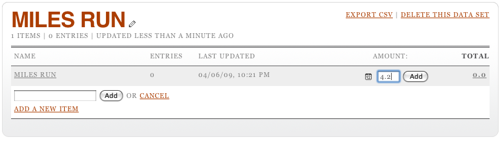
<p>This item will show up in the user interface, so pick its name well. For our purposes, the only thing this counter is tracking is miles run, so "Miles Run" is an obvious name. As you add the item, you'll see the interface now ask for an amount.</p>

<p><img src="http://husk.org/blog/imgs/dt/daytum-04-add-data.png"></p>

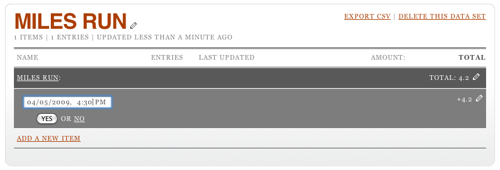
<p>I'm adding 4.2 miles run. Click Add and the total will be update to reflect this. But I didn't just run 4.2 miles; I did that yesterday afternoon. To edit the date, you have to click on the total, then on the pencil icon that appears when you hover over the row that's revealed. This opens up a date editing widget. (Note it's always in US date format. Oh well.)</p>

<p><img src="http://husk.org/blog/imgs/dt/daytum-06-edit-row-date.png"></p>

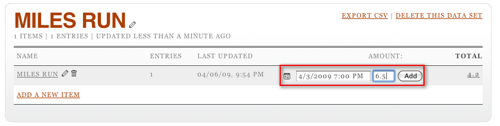
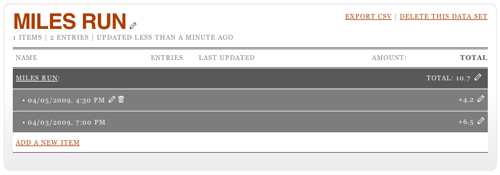
<p>You can also edit the amount by, again, clicking on the pencil at the other end of the row. It turns out that it's possible to set the date and time when adding a row, too: click on the little calendar icon (it says "12" on it) before you submit your amount. This will let you see two rows when you click on the total.</p>

<p><img src="http://husk.org/blog/imgs/dt/daytum-07-add-row-with-date.png"><br />
<img src="http://husk.org/blog/imgs/dt/daytum-08-show-data-rows.png"></p>

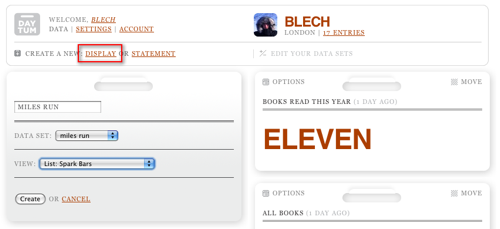
<p>So, now you're adding data happily every time you run, but nobody in the world can see this. For that, you need to go back to your home page on Daytum and add a display.</p>

<p><img src="http://husk.org/blog/imgs/dt/daytum-09-create-display.png"></p>

<p>Note that this is where that "data set" name that nobody else sees is used: it ties a display to an underlying counter. You can also play around with different visualisation options; I'm partial to "Spark Bars" but you might prefer something else.</p>

<p><img src="http://husk.org/blog/imgs/dt/daytum-10-display-spark-bar.png"></p>

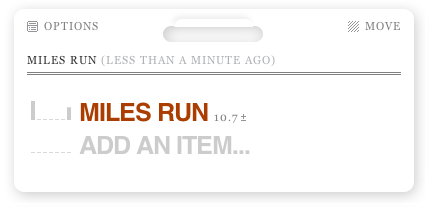
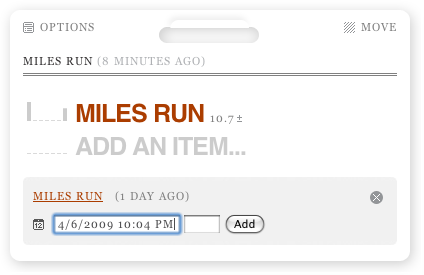
<p>Hey presto, there's your progress. Or, in the case of my completely artificial data, lack of it. However, there's a nice trick here: the ± icon next to the total can be clicked on to allow you to add data directly from the display. You'll also note the same calendar icon, allowing you to back (or forward) date entries.</p>

<p><img src="http://husk.org/blog/imgs/dt/daytum-11-add-row-from-display.png"></p>

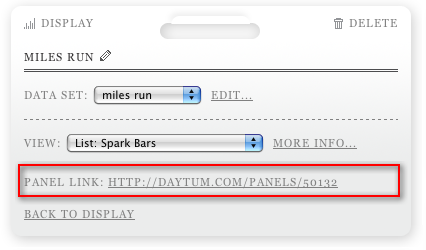
<p>There's one final trick to mention. Once a display's been set up, click on "Options" at the top left and you can get a link direct to that panel.</p>

<p><img src="http://husk.org/blog/imgs/dt/daytum-12-panel-link.png"></p>

<p>Hopefully this has helped someone else who was a bit confused cut to the heart of the Daytum site.</p>]]>
        
    </content>
</entry>

<entry>
    <title>Thoughts From the Open Platform</title>
    <link rel="alternate" type="text/html" href="http://husk.org/blog/arch/open_platform.html" />
    <id>tag:husk.org,2009:/blog//1.103</id>

    <published>2009-03-16T22:52:13Z</published>
    <updated>2009-03-17T12:54:36Z</updated>

    <summary>Three thoughts I had after the launch of the Guardian&apos;s Open Platform last week.</summary>
    <author>
        <name>Paul Mison</name>
        <uri>http://husk.org/</uri>
    </author>
    
        <category term="computing" scheme="http://www.sixapart.com/ns/types#category" />
    
        <category term="essays" scheme="http://www.sixapart.com/ns/types#category" />
    
    
    <content type="html" xml:lang="en" xml:base="http://husk.org/blog/">
        <![CDATA[<p>Last November, I was lucky enough to get an invite to the Guardian's first hack day, which commenced with signing an NDA for their forthcoming API. Last Tuesday, I got up early to go to the shiny new Kings Place offices to see the Open Platform launch, and there were three things I wanted to post about it.</p>
<p>The first has been well covered: how <a href="http://www.scripting.com/stories/2009/03/10/folksthisisinnowayopen.html">open it is</a>. I was initially hesitant about this too, but unlike the sites that have launched APIs until now, which are largely built on user-generated content (for once, the phrase actually fits), the Guardian's opening up content which it's sold rather than given away for nearly two hundred years.</p>
<p>Meanwhile, Winer raises the question "You gotta wonder if when they get out of beta their competitors will be able to repurpose their content. My guess is not" when that was the first question raised in the launch Q&amp;A (and it's been reported since, not least on <a href="http://rooreynolds.com/2009/03/11/guardian-open-platform/">Roo Reynold's excellent writeup</a>); it was answered (more or less) with a yes. The situation isn't ideal, and I still don't have an API key, but it's a very different beast from an service whose goals include backing up your own content. For now, I'll forgive them.</p>
<p>The second was on the subject of the <a href="http://www.guardian.co.uk/data-store">Data Store</a>, the Guardian's curated selection of "facts you can use", as the title puts it. The spreadsheets are hosted on Google Docs, but to edit them online you have to export them as Excel and then reimport them.</p>
<p>This seems incredible to me now, having been exposed to the joy of <a href="https://github.com/">GitHub</a> and its easy forking. Why not allow people to spawn editable copies of a spreadsheet, directly linked back to an authoritative source, keeping their own views (including visualisations)? Admittedly, this is a project more for Google (or a competitor to them) than the Guardian, but it'd be great.</p>
<p>(As a side note, I found the post by <a href="http://puffbox.com/2009/03/10/guardian-data-store-google-ons/">Simon Dickson on Data Store</a> quite interesting. I did once spend some time grappling with ONS spreadsheets, and found them quite hard to work with. Unfortunately, a quick look at the Guardian's selection shows some of the same problems - heading rows that interfere with columns, for example. Again, a forking model would allow the emergence of semi-canonical clean data sets, which would be great.)</p>
<p>The final point was even more tangentially linked to the Guardian's APIs, but it did spring to mind in discussions (with, I think, <a href="http://takeoneonion.org/">Gavin Bell</a> in the immediate aftermath). It arose after talking about the demo <a href="http://www.jaggeree.com/">Chris Thorpe</a> wrote for the launch, <a href="http://www.contenttagger.org/">Content Tagger</a>, which combines the Guardian's tags with those in Freebase's ontology and the hive mind's tags from delicious.</p>
<p>As Chris says in his <a href="http://blog.jaggeree.com/post/85891242/three-libraries-a-framework-and-an-api-how">writeup</a> (which is well worth reading), "Tom Coates' vision of the <a href="http://www.plasticbag.org/archives/2005/04/the_age_of_pointatthings/">Age of Point-at-Things</a> is fast becoming the age of point at resources and link them all together," and what seems to be linking things together more and more often is the tag.</p>
<p>More specifically, <b>machine tags are foreign keys</b>. (Well, they can be other things, too. But they're very good at that in particular.) For example, I can imagine a script that adds tags to delicious based on the Guardian's tags for their own stories, but prefixed with "guardian:" or "guardian:tag=" so that they don't clutter my tags. Similarly, <a href="http://snaptrip.appspot.com/">snaptrip</a> links Flickr to Dopplr, like the popular lastfm: and upcoming: machine tags, while the <a href="http://www.flickr.com/groups/api/discuss/72157615334960342/">recently-launched</a> <a href="http://apps.facebook.com/fonflickr/">Friends on Flickr</a> Facebook app uses, guess what, facebook:user= machine tags.</p>
<p>Content Tagger doesn't directly use machine tags that way, but it struck me that it might be a useful way to think about them in the future.</p>
<p>In any case, it was a privilege to attend the launch, and I'm happy to have had a few thoughts spurred by it.</p>]]>
        
    </content>
</entry>

<entry>
    <title>The Impossibility Of Ticketing</title>
    <link rel="alternate" type="text/html" href="http://husk.org/blog/arch/the_impossibility_of_ticketing.html" />
    <id>tag:husk.org,2009:/blog//1.102</id>

    <published>2009-02-26T15:14:51Z</published>
    <updated>2009-02-26T15:15:57Z</updated>

    <summary>BarCamp London seems to be hideously oversubscribed. Surely a true lottery would be fairer than the fastest-reloader system currently in place?</summary>
    <author>
        <name>Paul Mison</name>
        <uri>http://husk.org/</uri>
    </author>
    
        <category term="essays" scheme="http://www.sixapart.com/ns/types#category" />
    
        <category term="social gatherings" scheme="http://www.sixapart.com/ns/types#category" />
    
    
    <content type="html" xml:lang="en" xml:base="http://husk.org/blog/">
        <![CDATA[<p>BarCamp London 6 is in a month or so, and everyone's trying to get a ticket. Well, so it seems, anyway. Two batches have so far been released, and both have been allocated within a minute. It's so ridiculous, I don't even think I can be bothered trying.</p>
<p>I've complained about this sort of thing before, way back when, on the 2lmc spool, when that was extant. Even then, rather than just grousing, I had a suggestion.</p>
<p>Given the current ticket allocation system is a lottery, why not, well, make it a fair one? Rather than giving tickets based on who can hit "reload" in a browser fastest, leave the ticket system open for as long as the current wave system lasts (well over a week, so far), and let everyone apply for a ticket. Then, close the system, and randomly allocate the number of tickets available to the list.</p>
<p>This seems to me to be a far fairer solution. Of course, there are other ways of doing this. A nominal fee - something like the £12 charged by <a href="http://rubymanor.org/">Ruby Manor</a>, or the £20 for Interesting - would also have the effect of trimming the entrance list, and it might stop some of the encroaching commercialisation of the event. (Anyway, does every BarCamp really need its own tshirt?)</p>
<p>After I ranted about this in the pub, Gavin Bell suggested another model, an <a href="http://takeoneonion.org/archives/2009/02/seed16-a-new-model-for-co.html">invite network</a>, under the name seed16. In the comments on that piece, Simon Wistow suggested that, if going with friends is important, you could let people apply for tickets <a href="http://takeoneonion.org/archives/2009/02/seed16-a-new-model-for-co.html#comment-16201">en masse</a>, and vary the lottery model in different ways.</p>
<p>I'm sure the BarCamp people have a lot of work to do in getting their conference running, and having organised a few events for london.pm way back when, I know it's easy to criticise. I do think that ticketing has become something of a farce, though, and it's got to be worth considering different approaches.</p>]]>
        
    </content>
</entry>

<entry>
    <title>Saving State and Programming</title>
    <link rel="alternate" type="text/html" href="http://husk.org/blog/arch/saving_state.html" />
    <id>tag:husk.org,2009:/blog//1.101</id>

    <published>2009-02-20T22:32:00Z</published>
    <updated>2009-02-20T22:38:24Z</updated>

    <summary>Computers should save state, just as they should look after files. The biggest problem is probably programmer mentality.</summary>
    <author>
        <name>Paul Mison</name>
        <uri>http://husk.org/</uri>
    </author>
    
        <category term="computing" scheme="http://www.sixapart.com/ns/types#category" />
    
        <category term="essays" scheme="http://www.sixapart.com/ns/types#category" />
    
    
    <content type="html" xml:lang="en" xml:base="http://husk.org/blog/">
        <![CDATA[<p>John Gruber just posted one of his (increasingly rare) long-form posts, on the subject of <a href="http://daringfireball.net/2009/02/untitled_document_syndrome">untitled documents</a>, friction, and computers handling the boring things for you. He picks an example from a recently-released piece of software:</p>

<blockquote> BBEdit 9 has a good implementation of such a feature. Once a minute, it silently and invisibly stores copies all open documents. If BBEdit crashes or otherwise exits abnormally (like, say, if the entire system goes down), when next you launch BBEdit, it restores your work to the last auto-saved state. </blockquote>

<p>I agree, it's a great feature. I ranted years ago about <a href="http://husk.org/blog/arch/the_state_of_viewing_music.html">saving state in iTunes</a> (an app that Gruber deservedly celebrates for hiding a tedious implemenation detail - the on-disk layout of your files - from the user). The thing that's surprising me is that programmers have become so used to the idea that an application should be a blank state at startup, that they <a href="http://groups.google.com/group/bbedit/browse_thread/thread/04fb11b472790b35">actively think anything else is a bug</a>:</p>

<blockquote>I'm getting a strange behavior in BBEdit 9.1. When I launch BBEdit it mysteriously opens all the files I had open when BBEdit was last quit.</blockquote>

<p>How did we get to this state? If you come back into your office on Monday morning and your papers aren't where you left them, you swear under your breath at the cleaner, not think "oh, good, someone reset my working environment". I don't see any reason why my computer shouldn't be the same as my office desk is: everything should be where (and how) I left it.</p>

<p>I think there's a parallel between dynamic languages and saving state that Gruber doesn't explicitly state: they've both been enabled by all that computing power that twenty-five years of Moore's Law has put into my MacBook that wasn't in the original 128K Mac. Who cares if your language's compiler has to wrap <tt>print "hello world";</tt> in all that boilerplate for you? Similarly, writing out a few kilobytes of state information every now and again and reopening a few dozen files at app startup isn't going to kill you (especially when you only restart it once a fortnight).</p>

<p>Thankfully, all that time programmers save by not having to write boilerplate code should give them time to implement state-saving. They'll save even more when frameworks do it for them. Hopefully, by that point, users will expect it, too.</p>]]>
        
    </content>
</entry>

<entry>
    <title>Aggregation and the Edge</title>
    <link rel="alternate" type="text/html" href="http://husk.org/blog/arch/aggregation_and_the_edge.html" />
    <id>tag:husk.org,2009:/blog//1.100</id>

    <published>2009-02-17T11:42:28Z</published>
    <updated>2009-02-17T15:08:55Z</updated>

    <summary>The shape of the coming deeply-aggregated personal site.</summary>
    <author>
        <name>Paul Mison</name>
        <uri>http://husk.org/</uri>
    </author>
    
        <category term="computing" scheme="http://www.sixapart.com/ns/types#category" />
    
        <category term="essays" scheme="http://www.sixapart.com/ns/types#category" />
    
        <category term="meta [on blogging]" scheme="http://www.sixapart.com/ns/types#category" />
    
    
    <content type="html" xml:lang="en" xml:base="http://husk.org/blog/">
        <![CDATA[<p>A couple of years ago, I decided that there was something worth building that would be a combination of aggregation and social networking. People had done the first part (I used <a href="http://www.suprglu.com/">Suprglu</a>, for example, and you could (and still can) turn <a href="http://tumblr.com/">Tumblr</a> into an aggregator) and the second bit (at that point, Facebook was rapidly climbing) but the two hadn't really been put together.</p>

<p>Of course, within a few months, not only had Facebook sewn up the market for the casual user, while <a href="http://friendfeed.com/">FriendFeed</a> had emerged and become popular amongst the alpha geeks. I went off and built my own shallow-aggregation front page, while it seemed more than a few people decided the right approach was to cross post from every service to every other one (which annoyed me no end, and made me think that filters will eventually become very important- but that might be another post).</p>

<p>Now I'm beginning to see a new shape of software emerge from people's discussions. Its genesis probably came about after last year's XTech, when Jeremy Keith posted about Steve Pemberton's talk, <a href="http://adactio.com/journal/1468/">Why You Should Have A Web Site</a>:</p>

<blockquote>With machine-readable pages, we don't need those separate sites. We can reclaim our data and still get the value. Web 3.0 sites will aggregate your data (Oh God, he is using the term unironically).</blockquote>

<p>The idea lay germinating for a while, but it's emerged back into the spotlight because of the wave of site closures and database losses over the New Year. Users of Pownce found themselves without a site, and Magnolia's bookmarks were lost in a database crash, for example. If you have a deeply-aggregated site - one where you host a local store of data that's also on a remote service, like <a href="http://www.gyford.com/phil/writing/2009/02/10/front_page.php">Phil Gyford</a> and <a href="http://jerakeen.org/notes/2009/02/head-in-the-cloud-feet-on-the-ground/">Tom Insam</a> have built - then you, by definition, have a local backup.</p>

<p>I think doing things this way around - using the remote services as primaries, with your own site being fed from, but (if needs be) independent of them - makes the most sense. You can use the social networks of sites like Flickr, which are their strong points.</p>

<p>Now, I'm not there yet. My current site uses only shallow aggregation - I pull in links and posts, but I show them to the user and then forget them. The first step to making a proper site is to build a local database and start backing up to it. This is probably worth doing no matter what - in fact, it's the whole point of <a href="http://adactio.com/journal/1552">Jeremy Keith's most recent journal post</a> - and it turns out I have the seeds of the code I need in the scripts I wrote to generate my <a href="http://notes.husk.org/post/67858103/2008">2008</a> web posting statistics.</p>

<p>I'd already been considering using a <a href="http://www.metabrew.com/article/anti-rdbms-a-list-of-distributed-key-value-stores/">key-value or document store</a> rather than an RDBMS for this when I saw Jens Alfke's post on using <a href="http://mooseyard.com/Jens/2009/02/what-will-web-30-be/">CouchDB for a "Web 3.0" site</a> (look, it's that term again!) He notes that, while unfinishes, CouchDB looks like it may implement a usable system for replicating data at web scale, so that the social activity could finally move from specific sites to the <a href="http://www.oblomovka.com/wp/2008/07/24/video-from-living-on-the-edge-opentech-2008/">edge</a> (or at least, our own colos).</p>

<p>Now I'm wondering: is there a space for a piece of user-installable software, like Movable Type or Wordpress, that aggregates their data from sites across the web, and then presents it as a site? If there is, is it even possible to write it in a way that anyone who couldn't have written it themselves can even use it? Can I write it just for myself in the first place? I don't know, but in the next year, I think we'll find out.</p>]]>
        
    </content>
</entry>

<entry>
    <title>Making App Engine Production Ready</title>
    <link rel="alternate" type="text/html" href="http://husk.org/blog/arch/gae_production_ready.html" />
    <id>tag:husk.org,2009:/blog//1.99</id>

    <published>2009-02-11T10:31:49Z</published>
    <updated>2009-02-13T11:09:03Z</updated>

    <summary>Google App Engine is getting quite a lot of love at the moment, but it really needs the ability to pay for resources to make it into the mainstream.</summary>
    <author>
        <name>Paul Mison</name>
        <uri>http://husk.org/</uri>
    </author>
    
        <category term="computing" scheme="http://www.sixapart.com/ns/types#category" />
    
        <category term="essays" scheme="http://www.sixapart.com/ns/types#category" />
    
    
    <content type="html" xml:lang="en" xml:base="http://husk.org/blog/">
        <![CDATA[<p>It's probably because I've just subscribed to <a href="http://googleappengine.blogspot.com/">their weblog</a>, but the Google App Engine team seems to be generating a lot of activity at the moment. In addition, it seems as that the platform itself is getting more attention. As a user of the service, there are some threads in all of that I'd like to tie together.</p>

<p>Most recently, the <a href="http://googleappengine.blogspot.com/2009/02/sdk-version-119-released.html">1.19 release of the SDK</a> brought urllib, urllib2 and httplib compatibility. This means that the sort of fixed I talked about for snaptrip, where I had to <a href="http://snaptrip.blogspot.com/2008/12/snaptrip-talking-to-flickr-with-gae.html">patch Beej's Python Flickr library</a>, is no longer necessary- any web API module should work on GAE without needing any patches or special work on the part of the author.</p>

<p>1.19 also introduces a <a href="http://code.google.com/appengine/docs/python/tools/uploadingdata.html">bulkloader and a remote data API</a>. Personally, I seem to be able to get by without databases for most of the projects that end up live, but for the majority of other developers, a robust backup / restore service is a necessity. As yet, bulkloader is only half of the picture, but it indicates both parts of the problem are getting attention. Finally, 1.19 ups the request and response limits to 10MB from 1; useful for moderately-sized PDFs, for example.</p>

<p>Further away, an <a href="http://googleappengine.blogspot.com/2009/02/roadmap-update.html">earlier post discussed some additions to the <a href="http://code.google.com/appengine/docs/roadmap.html">App Engine roadmap</a>. For me, by far the most important is the promise of background tasks and task queues, which would be very useful for building a local cache of Flickr data. There's also mention of XMPP, which would be fun, and the ability to receive email, which I can see being useful also.</p>

<p>In the wake of these announcements, I've been <a href="http://danhon.com/2009/02/09/links-for-2009-02-09/">asked</a>: "is GAE ready for production?" I'd say the answer lies not with these features (although I'm sure some projects would require them), but with the continued beta status, and more concretely, the inability to pay Google money to use extra computing resources.</p>

<p><a href="http://aralbalkan.com/category/development/google-app-engine">Aral Balkan</a> gave <a href="http://aralbalkan.com/1903">an amusing and informative talk</a> at the <a href="http://groups.google.com/group/django-london">London Django user group</a> last month, covering his issues with hosting the <head> conference website on App Engine. While he mentioned workarounds for long-running processes, data portability, and large files, I believe the single key thing that would have made his task easier is the ability to pay Google money to use more nodes, and hence make Over Quota wrnings go away.</p>

<p>It is somewhat ironic that Google can evidently scale, and that App Engine is not only designed for scale, but enforces scaling on the design of your application, but that sites hosted on it can't take full advantage yet. Once the current limits go from being a brick wall to a toll gate, the site will be far more attractive for serious work, and I might even recommend it as production-ready.</p>]]>
        
    </content>
</entry>

<entry>
    <title>iPhoto &apos;09, Scripting, and Flickr</title>
    <link rel="alternate" type="text/html" href="http://husk.org/blog/arch/iphoto_09_applescript_flickr.html" />
    <id>tag:husk.org,2009:/blog//1.98</id>

    <published>2009-02-01T17:05:00Z</published>
    <updated>2009-02-01T17:05:53Z</updated>

    <summary>I have a look at the updated iPhoto&apos;s scripting support. Unfortunately, it&apos;s not that good, but there might be something useful under the hood.</summary>
    <author>
        <name>Paul Mison</name>
        <uri>http://husk.org/</uri>
    </author>
    
        <category term="computing" scheme="http://www.sixapart.com/ns/types#category" />
    
    
    <content type="html" xml:lang="en" xml:base="http://husk.org/blog/">
        <![CDATA[<p>Another year, another release of iPhoto. This time, though, I was particularly interested, since two of its three headline features - Flickr integration and maps - tickled my fancy. (We'll see how much I care about Faces, but I tend not to take photos of people all that often, so it's perhaps not much use to me.)</p>

<p>In particular, the promise of two-way Flickr sync was too good to pass up. A year or so ago I made <a href="http://blech.vox.com/library/post/flickr-and-iphoto-across-the-scripting-bridge.html">a bit of an effort</a> to work towards this, but I never managed to get it to a state I could use. However, I always suspected that getting iPhoto to know about past photos would be impossible, and it seems from Fraser Speirs post on <a href="http://speirs.org/2009/01/30/on-the-flickr-support-in-iphoto-09/">iPhoto's Flickr integration</a> that I was right.</p>

<p>However, I still thought it was worth an attempt at having a look. My first investigative step was to set up a Flickr album and get some photos into it. Then I opened up Script Editor, and, as <a href="http://twitter.com/fraserspeirs/status/1161482021">Fraser Speirs reported</a>, found the "publised album" type of an album was the only indication you can get from AppleScript that photos are shared, and it's a read-only property, as is the URL that the album is published at.</p>

<p>This means that photos don't have any indication that they're on Flickr at all, and there's no way to find the URL or ID of a particular image. The two-way sync on a published album means that adding a photo in iPhoto creates a new image in Flickr, while adding an existing photo to a set that's been created by iPhoto will cause it to download the original, making a duplicate in your library.</p>

<p>On the wider note, AppleScript has seen no changes that I noticed in the new version. Photos now have faces, places and descriptions; none of them are exposed via the scripting interface. It's also still impossible to assign a keyword via Apple Events unless it already exists in iPhoto, which is deeply annoying (especially given you can in the regular UI).</p>

<p>So, there's no way to retrofit Flickr photos? Well, probably. The one possibility I can see is that iPhoto now uses SQLite (and maybe Core Data?) for its database, so you can open it up and have a look. There are some promising avenues there - there's an SgPublishedAlbum table, containing persistentPhotoData - but first I'll need to figure out how (indeed, if) it's possible to take the binary data stored there and read it, let alone write it. (This avenue might also let me add keywords easily: they're stored in their own SQLite table.)</p>

<p>Ah well. If Apple were perfect, what would we all have to write about?</p>]]>
        
    </content>
</entry>

<entry>
    <title>Ruby, Flickr, APIs, and Flickraw</title>
    <link rel="alternate" type="text/html" href="http://husk.org/blog/arch/flickraw-ruby-flickr-library.html" />
    <id>tag:husk.org,2009:/blog//1.96</id>

    <published>2009-01-21T10:38:25Z</published>
    <updated>2009-01-21T10:43:55Z</updated>

    <summary>Additional notes and URLs for a talk I gave at LRUG on the subect of Flickr API libraries and Ruby.</summary>
    <author>
        <name>Paul Mison</name>
        <uri>http://husk.org/</uri>
    </author>
    
        <category term="computing" scheme="http://www.sixapart.com/ns/types#category" />
    
        <category term="social gatherings" scheme="http://www.sixapart.com/ns/types#category" />
    
    
    <content type="html" xml:lang="en" xml:base="http://husk.org/blog/">
        <![CDATA[<p>Last week, I gave a short talk at the London Ruby User Group that I titled "Avoiding API Library Antipatterns". It's really about what not to do when you're writing a library to use Flickr's API (although I think there's a lot you can learn for any RESTian service provider from the experience). You can see the <a href="http://www.slideshare.net/blech/avoiding-api-library-antipatterns-presentation-918028">slides at Slideshare</a> and there's even a <a href="http://skillsmatter.com/podcast/ruby-on-rails/abstractions-for-website-apis">video of the talk</a> at Skills Matter, who hosted the event.</p>

<p>So, what was the gist? Rather than writing lots of boilerplate code to handle every Flickr method, and wrap the returned XML into objects, instead use a generic caller and JSON to eliminate much of your work. If you're able to, use reflection to provide convenience methods. As a result, I use <a href="http://flickraw.rubyforge.org/">flickraw</a>, because it's the only Ruby library I've seen that does things this way.</p>

<p>One of the weakest points of the talk was that I didn't cover how Flickr's responses don't just change when the API changes. Most methods take the 'extras' parameter, which allows you to flesh out the returned data with additional fields, such as the dates the photo was taken and uploaded. Naive libaries require <a href="http://husk.org/code/rflickr.patch">patching</a> to deal with this; smart ones, handing back the response with minimal changes, don't.</p>

<p>I also shied away from explicitly putting in the slides many of the recent <a href="http://husk.org/labs/">projects</a> I've built, including where? what? when? and the machine tag browser, which rely on using new API methods. If you're stuck behind a poor library, there are cool toys you won't be able to write without fighting it, and software's meant to help, not be hateful.</p>

<p>The talk itself was surprisingly quick to deliver; I blew through the slides in ten minutes, allowing lots of time for questions, which were (thankfully) interesting and insightful. The suggested use of method-missing to provide syntactic sugar (calling flickr.photos.search not flickr.call(flickr.photos.search), for example) if an API doesn't provide reflection (or if the library author wants to avoid having to fetch method information) sticks in my mind as a point that's worth repeating.</p>

<p>This was my first talk to a language-specific group outside Perl, and I'm fairly happy with how it went, so thanks to LRUG for listening and being so welcoming, and I hope readers here also get something out of the talk.</p>]]>
        
    </content>
</entry>

<entry>
    <title>A Resolution For 2009</title>
    <link rel="alternate" type="text/html" href="http://husk.org/blog/arch/a_resolution_for_2009.html" />
    <id>tag:foil.husk.org,2009:/blog//1.95</id>

    <published>2009-01-13T23:18:07Z</published>
    <updated>2009-01-20T23:30:39Z</updated>

    <summary>My new year&apos;s resolution is to keep returning to old projects and extending them. It&apos;s not that exciting, but I hope I can do it anyway.</summary>
    <author>
        <name>Paul Mison</name>
        <uri>http://husk.org/</uri>
    </author>
    
        <category term="computing" scheme="http://www.sixapart.com/ns/types#category" />
    
        <category term="essays" scheme="http://www.sixapart.com/ns/types#category" />
    
    
    <content type="html" xml:lang="en" xml:base="http://husk.org/blog/">
        <![CDATA[<p>I know that it's not quite the fresh new year any more, but I still have the metaphysical hangover from the new digit in the number. I never did properly finish doing any visualisation on my <a href="http://notes.husk.org/post/67858103/2008">raw web output statistics</a> for last year, and I've not properly written up my new year's resolutions either.</p>

<p>Anna Mondo thinks that it's a <a href="http://mondoagogo.com/2009/01/05/on-the-arbitrary-nature-of-new-years-resolutions-sort-of/">bad time for resolutions</a>, and for health issues she's probably right- you need comfort. For programmers, though, new year feels like a good time to do things: it's dark and cold out, so the natural "hide at home" inclination is actually looked on with less scorn by the rest of world, and what better arbitrary turnover point is there?</p>

<p>So, what do I want to do? Over the last year I've definitely branched out; I've released code in languages that were new to me, letting JavaScript, Python and Ruby compete with Perl for my attention. I had a fairly productive end-of-year, complete with a lot of Flickr toys and an interview on their code site (which was a very pleasant surprise.) So, what do I need to change next year?</p>

<p>I think there are two ways to go. I agree with Giles Bowkett that <a href="http://gilesbowkett.blogspot.com/2008/12/no-new-language-in-2009-new-habits.html">new languages aren't the way to go</a>, but I disagree with him that starting lots of new projects is. Instead, I'm taking some advice from Jonathan Rasmusson on <a href="http://rasmusson.wordpress.com/2009/01/05/how-to-become-a-better-programmer/">how to become a better programmer</a>: keep working on things.</p>

<p>His post, evidently, is from the point of view of a commercial freelancer, but some of the same lessons apply to personal projects. It's tempting to launch them, and then watch as the world notices, and move on, allowing others to take it further. I don't think I'm really happy with that, though. groupr, snaptrip and the two most recent Flickr API explorations all ended up with items left on their todo list, and it's poor form to leave them unfinished forever (even if they did reach a point where there was enough to publish them).</p>

<p>Beyond that, though, there's the worth of making sure your code is readable after a time, by returning to it, and the related skill of refactoring, as you go back and do things better. As Rasmusson says: "You basically miss out on all the great feedback that would tell you where you kicked butt, and where you screwed up. All of which would of course help you on your next project."</p>

<p>Of course, that doesn't entirely mean "no new projects". I'm only human, and anyway, there are a couple of things that I've left in half-finished pieces for so long that, to my mind, they almost count anyway. Nonetheless, I hope to go back and extend existing stuff too. Perhaps that's just something I should be doing anyway, but then, aren't most resolutions? Happy new year.</p>]]>
        
    </content>
</entry>

</feed>